Well the first evening was a bust as I spent most of the evening in the ER as a family member got taken there. No it was not me this time. I did manage to work K7CA in Nevada but I did not log it as I got the phone call to go to the ER. I may have to search for NV again tonight
The states that I need to complete WAS are NV, WA, NE, MT, AK - just five more. AK is sure to get a pileup
I did get K7CA a second time for a good QSO, but he was not in Nevada but in UT working a contest station he built.
Update: Just worked WA K7OX, N7QT, W7LD
Also worked MT K7BG, and NV KM6JD
I also got into Luxembourg LX7I
I also worked England G3LET
Saturday, January 28, 2017

Thursday, January 26, 2017
KU4XO's 2 Year Run on 160m and my current pursuit in "topband"
KU4XO two year run is shown by the chart below. He actually started in late winter 2015 after I got into 160m in the fall of 2014.
 What is notable about KU4XO's run was that he was able to do it from a small lot without any kind of a receive antenna. He was inspired by an article written by WB6RSE in QST March 2016 Page 66-68 about the pursuit of 160m DXCC from a small city lot. It took him (WB6RSE) 6 years to obtain DXCC on 160m between 1998 and 2004. He worked the 1st 60 countries with 100 watts. His pace did step up when he added the inverted L with 3 radials.
I too, have a small lot. My run on 160m started in 2014. I installed an inverted L with 4 elevated radials and worked the 160m contests that winter. After that winter I concentrated on getting to 300 DXCC and DX Marathon QRP and took a hiatus on 160m. I took down the 160m inverted L and put up a 30m delta loop.
As one can see my 160m had a very pronounced lull from the chart below:
The run ended abruptly in the Spring of 2015. I felt I needed more power and a better antenna. More power came in the form of an old Clipperton L that will do KW on 160m. I had put in a brand new set of high voltage capacitors in the power supply. I tested it and found that it will push 1000W with 100W of drive. (See my post in May 2016). I really have not had to push power past about 750W and for the most part gotten away with mostly using the KPA500 since I still had the "old reliable". In January of 2017 I had put up a folded counterpoise (FCP) design espoused by K2AV and W0UCE (SK). It only has a 66 foot folded counterpoise from 174 feet of solid copper wire which takes up very little space. It requires a specially designed isolation transformer. There are many articles on this design on the net.

I did have a good run for a few days in January but it still remains to be seen whether I can keep up this pace. I already see that it will likely slow down. Below is a picture of the installation of the FCP Inverted L. The radiator is 150 feet long and I nailed the SWR without pruning. It is reasonably flat from 1800-1835 with SWR < 2 and then I have to add inductance above 1835. I could remove a few inches and center the dip in the SWR to about 1.825 but fooling with the set-up might do more harm than good since the proximity of the horizontal radiator to ground might change the capacitive coupling. I think I will leave well enough alone. Not a big chore adding inductance through the tuner.

Here is the SWR Curve
 In terms of how it plays - the stateside stations in the CQ WW 160m Contest are loud and the noise floor is about S3 during the contest. The K9AY is down in noise about 12 dB or 2 S units.

I too, have a small lot. My run on 160m started in 2014. I installed an inverted L with 4 elevated radials and worked the 160m contests that winter. After that winter I concentrated on getting to 300 DXCC and DX Marathon QRP and took a hiatus on 160m. I took down the 160m inverted L and put up a 30m delta loop.
As one can see my 160m had a very pronounced lull from the chart below:
The run ended abruptly in the Spring of 2015. I felt I needed more power and a better antenna. More power came in the form of an old Clipperton L that will do KW on 160m. I had put in a brand new set of high voltage capacitors in the power supply. I tested it and found that it will push 1000W with 100W of drive. (See my post in May 2016). I really have not had to push power past about 750W and for the most part gotten away with mostly using the KPA500 since I still had the "old reliable". In January of 2017 I had put up a folded counterpoise (FCP) design espoused by K2AV and W0UCE (SK). It only has a 66 foot folded counterpoise from 174 feet of solid copper wire which takes up very little space. It requires a specially designed isolation transformer. There are many articles on this design on the net.

I did have a good run for a few days in January but it still remains to be seen whether I can keep up this pace. I already see that it will likely slow down. Below is a picture of the installation of the FCP Inverted L. The radiator is 150 feet long and I nailed the SWR without pruning. It is reasonably flat from 1800-1835 with SWR < 2 and then I have to add inductance above 1835. I could remove a few inches and center the dip in the SWR to about 1.825 but fooling with the set-up might do more harm than good since the proximity of the horizontal radiator to ground might change the capacitive coupling. I think I will leave well enough alone. Not a big chore adding inductance through the tuner.

Here is the SWR Curve

Tuesday, January 17, 2017
New Mission For 2017 - 160m DXCC
There - I wrote it down to hold myself accountable for it. The inspiration, wake up call, challenge, or whatever you might call it came from fellow ham and friend KU4XO. He finished his assault on 160m in 2016 and is now on the verge of 9 band DXCC. He did it without a listening array and a transmit antenna for 160m built on a small lot. It reminded me of a similar assault I made on 80m during the winter of 2013-2014 during which I rocketed my DXCC totals from 20-116 witha somewhat inefficient inverted L. (It had to be inefficient because my impedance was close to 50 ohms and you had to be at 36 ohms to get to 100% efficiency. Unfortunately you had to lay down 120 1/4 wave radials to get there. I only had 1/8 wave radials numbering about 30). Despite this handicap I succeeded. I actually plotted the timeline as shown below:

KU4XO had a similar handicap on 160m yet he succeeded - through effort and patience.
During all of 2016 I had not done much in the low bands. In fact I took down my inverted L as I was concentrating on the DX Marathon Formula 5W and managed a score of 201. I put up a 30m delta loop instead. It was a decent effort on the DX Marathon but not good enough to break into the top 5 world wide.
Now it is time to renew the assault on 160m. I just called the Wireman for 130 feet of 12 gage copper for the folded counterpoise proposed by K2AV and W0UCE. I also ordered the specially constructed isolation transformer for this counterpoise design from Balun Designs. I should have this antenna up in the air by this weekend. Wish me luck.
Just to be clear, I am not starting from scratch (35 confirmed out of 41 worked) and it is kind of getting late in the winter. Here are tips from KU4XO for posterity:
"New country 2016 mode break down 68 CW, 14 SSB, 16 JT65
This was the trifecta for me reverse beacon network for CW, JT65 for digital, DX cluster for voice. Using this method I was able to cover all modes at once.
The very most important point is (I know you probably already know this) there is DX out there on CW that never gets spotted on the DX cluster. This is where the reverse beacon network comes in. If anyone calls CQ the skimmers will pick it up before anyone has a chance to work em. That’s your chance to be the first to work em before the pile builds assuming it’s rare enough for a pile to build.
More about timing………4:30am – 8am
If you already have these four countries Japan, New Zealand, Australia, Asiatic Russia then you can sleep in unless there is a DXpedition to the pacific you can feel safe that you probably not going to miss anything. If you don’t already have these four then it is the perfect opportunity to pick em up or work the DXpedition.
Things you may not want to do:
Another thing that helped me is having something to do while waiting for the DX to roll in. I listen to talk radio in the shack it helps me stay focused and awake ready to pounce when that new one comes along."
Thank you Matt (KU4XO) for these tips.

KU4XO had a similar handicap on 160m yet he succeeded - through effort and patience.
During all of 2016 I had not done much in the low bands. In fact I took down my inverted L as I was concentrating on the DX Marathon Formula 5W and managed a score of 201. I put up a 30m delta loop instead. It was a decent effort on the DX Marathon but not good enough to break into the top 5 world wide.
Now it is time to renew the assault on 160m. I just called the Wireman for 130 feet of 12 gage copper for the folded counterpoise proposed by K2AV and W0UCE. I also ordered the specially constructed isolation transformer for this counterpoise design from Balun Designs. I should have this antenna up in the air by this weekend. Wish me luck.
Just to be clear, I am not starting from scratch (35 confirmed out of 41 worked) and it is kind of getting late in the winter. Here are tips from KU4XO for posterity:
"New country 2016 mode break down 68 CW, 14 SSB, 16 JT65
- Make sure to be on @ 12am -3am peak time if you can be on before then great but these are the hours that consistently put new ones in the log for me.
- Be open to all modes, watch the reverse beacon network on 160m CW exclusively http://www.reversebeacon.net/
- Have JT65 up and running at all times with radio tuned to 1.838 when not in QSO CW or voice. Have Hamspots.net open to see what DX is being spotted on the digital modes.
- Watch the DX cluster for SSB contacts I use http://www.dxsummit.fi/ but whatever cluster you prefer as long as it can show all modes 160m only.
This was the trifecta for me reverse beacon network for CW, JT65 for digital, DX cluster for voice. Using this method I was able to cover all modes at once.
The very most important point is (I know you probably already know this) there is DX out there on CW that never gets spotted on the DX cluster. This is where the reverse beacon network comes in. If anyone calls CQ the skimmers will pick it up before anyone has a chance to work em. That’s your chance to be the first to work em before the pile builds assuming it’s rare enough for a pile to build.
More about timing………4:30am – 8am
If you already have these four countries Japan, New Zealand, Australia, Asiatic Russia then you can sleep in unless there is a DXpedition to the pacific you can feel safe that you probably not going to miss anything. If you don’t already have these four then it is the perfect opportunity to pick em up or work the DXpedition.
Things you may not want to do:
- checking the spectrum analyzer for signals and tuning the VFO (hunt and pounce) because you might miss something on JT65 let the cluster do the work for you. New ones on SSB are rare unless in a contest.
Another thing that helped me is having something to do while waiting for the DX to roll in. I listen to talk radio in the shack it helps me stay focused and awake ready to pounce when that new one comes along."
Thank you Matt (KU4XO) for these tips.
Sunday, January 15, 2017
Snow storm in SC and My Hexbeam

The hexbeam was a mangled mess but none of the spreaders broke. It is all back to normal now
Wednesday, January 11, 2017
Evaluating the IC7300

This is one nice rig. SDR at the price point of a Kenwood TS590. It has a built in Panadapter - not as nice as the PX3 but quite functional. It takes getting used to the touch screen controls. It has a built in tuner. Size wise it is just as small as a K3 or TS590. Audio sounds good - with the NR - QRN can be tamed.
DX Marathon 2016 - Did not break top five
Looks like I got beat out by K4AR from Tennessee with a score of 216. It also means that I also lost out in the top spot from W4. Better luck perhaps in 2017. The scores from 2016 bested the scores from 2015 in the Formula 5 class. The 2016 scores have not been screened for bad calls, pirates, etc.


2016

2015

Monday, January 2, 2017
Bayou Jumper is Now QRV -
This is a replica of the WW2 Era parasets constructed by the British and dropped behind enemy lines via parachute - hence the name "Paraset". Here I am using an OHR Wattmeter to measure output RF. Watch the YouTube video below for a taste of the receive. Dave Anderson also constructed one and we will be demoing it at the next Greer Club meeting.

Friday, December 30, 2016
2016 - A Tale of Two Charts
Well 2016 is almost over and I can't find any more DX I can work QRP for a new one. Even with the waning of the sunspot cycles - I find myself having worked 19 ATNOS in 2016. 2016 is the year I broke 300 and 2016 is also the year that I was able to get the 5 Band Worked All Zones Award from CQ Magazine. The DXCC slope will be much flatter in 2017 than in 2016 and I will be lucky to get to 310. Being at 303 - I should be able to muster another sticker (305)

Chasing DX QRP was a lot of fun in 2016 and really just became an off shoot of the 100 day Challenge I started at the beginning of the year. It looks like I will be closing out the year with having worked 166 DXCC in 34 Zones for a nice round score of 200. I may get lucky and get one more. I finally got Greece working PSK. I am glad he kept calling CQ. With the band conditions up and down on 40m - it took quite a bit of answering his CQ at 5 watts. The band did get better 20 minutes in and he was finally able to get my call. I still don't have European Russia and European Turkey.
I checked all my entries and now ready to submit. My goal was 200 and I was just able to squeak that out. I was surprised as to how I got there - having worked ZL, VKs, 4S7, EL, E5 along the way.


Chasing DX QRP was a lot of fun in 2016 and really just became an off shoot of the 100 day Challenge I started at the beginning of the year. It looks like I will be closing out the year with having worked 166 DXCC in 34 Zones for a nice round score of 200. I may get lucky and get one more. I finally got Greece working PSK. I am glad he kept calling CQ. With the band conditions up and down on 40m - it took quite a bit of answering his CQ at 5 watts. The band did get better 20 minutes in and he was finally able to get my call. I still don't have European Russia and European Turkey.
I checked all my entries and now ready to submit. My goal was 200 and I was just able to squeak that out. I was surprised as to how I got there - having worked ZL, VKs, 4S7, EL, E5 along the way.

Thursday, December 29, 2016
DX Marathon Submission Almost Ready
Well I have analyzed the log for invalid call signs and submitted it to QScope to check for pirates, invalid call signs, etc and everything seems to pass. I still have a couple of days and perhaps I may be able to muster another DXCC or a new Zone.
So far 34 Zones out of 40
So far 34 Zones out of 40
Wednesday, December 28, 2016
Paraset Replica Project - Bayou Jumper
First a little bit of history:
Parasets are so named because they were spy radios built by the British in World War and were typically deployed behind enemy lines via parachute - hence the name "Para-set". Power output was 4-5 watts.
From Wikipedia: The Paraset was one of the first successful miniaturized radio sets for Britain's Special Operations Executive which conducted espionage and other activities behind German lines during World War II.


Parasets are so named because they were spy radios built by the British in World War and were typically deployed behind enemy lines via parachute - hence the name "Para-set". Power output was 4-5 watts.
From Wikipedia: The Paraset was one of the first successful miniaturized radio sets for Britain's Special Operations Executive which conducted espionage and other activities behind German lines during World War II.
The set, known as the Whaddon Mark VII, was used for clandestine radio communication primarily in Norway and Europe, developed at the Royal Signals Special Communications Unit workshops at Little Horwood and the workshops of Whaddon Hall, Buckinghamshire in the early stages of World War II. The equipment is known as the “Paraset” because it was dropped by parachute for field agents.[1][2][3]
A number of amateur radio operators build and operate replicas of the Paraset.[4]

The original parasets were regenerative receivers with crystal controlled transmitters. The two tubes on the upper left are the receiving tubes and the larger tube on the right is the transmitting tube. In the middle is a socket that is meant to take FT243 crystal holders for the single frequency that will be used for transmit. The regenerative receiver has very few parts and is built on the principle of regeneration by providing positive feedback with its output connected to its input through a feedback loop..
The project I am building is a modernized version of the Paraset which uses MOSFET transmitter section based on the NS40 transmitter designed by NM0S of the 4 States QRP group. The receiver is still a regenerative receiver. The transceiver is a single band single frequency transmitter. The transmit frequency can be changed by plugging in a different crystal. Here is a short demonstration video from the 4 States QRP Group.

The modernized version is shown above. Gone are the vacuum tubes. The main PCB is shown below:

I am still awaiting the arrival of the kit. As you can see, the board is a tight fit into the Hobby Lobby Chinese made boxes the PCB was sized for - so I made my own box. The box is US made in SC by me. In addition to accommodating the PCB, the box I built have compartments for a battery and antenna wire. I have crystals for 7030 (NAQCC), 7055 (SKCC), 7122 (QRP-ARCI and Bayou Jumper calling frequency). Larry Hastings, the kitter tells me my kit will go out in tomorrow mornings mail.

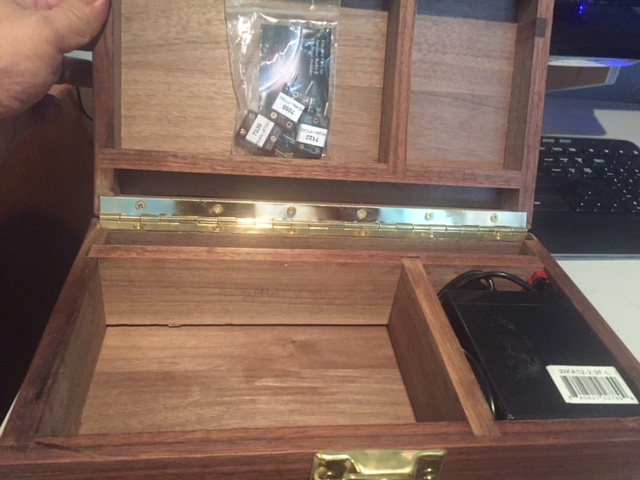

I tested the antenna wires today. It was set up as a resonant antenna for 40m as a quarter wave ground plane. I had a QSO with WA1HFF in Massachusetts transmitting 3 watts on my K1.
Monday, December 26, 2016
As the year 2016 .... comes to an end

- E51WDC on 17m for a new DXCC for DX Marathon
- ZL4YL - 15 y.o. young lady Xenia for a new DXCC for DX Marathon
- VK2DX - a new DXCC and a new Zone
- VO2NS - the ever so rare Zone 2 (so close yet so far)
- TL8AO and TL0A - a very rare DXCC entity - Central African Republic
- EL2DT - Liberia - favorite frequency is 14.042 - worked him with the K1
- CY9C - Expedition to Saint Paul Island
- 3B9FR - Close to being an antipode from where I am at over 10000 miles
- JM7OLW - Japan - 6713 miles and CQ Zone 25
- RI1ANR - Antartica -8800 miles and CQ Zone 38
- 4S7AB - Sri Lanka - 9313 miles on the grey line
- 3D2AG/P - Rotuma Island - 7736 miles and 1st time into Zone 32
DX Marathon QRP - Down to the Wire
This has been a very enjoyable year - even if I don't get anymore. Getting into Zone 32 with my puny signal is always a welcome sound - hearing the DX send NY4G 5NN. This is Milan OK1DWC in the South Cook Islands using a Spiderbeam. I was able to secure the QSO calling in between strong stations on 17m CW. I was surprised he came back to me - but he did.
 In the photo below is his daughter Natalie - already able to send 12 wpm at the age of 12. Notice the propagation map VOACAP on his computer monitor. Definitely a TS590 in the photo although the amp shown is a KPA500, he says he is using an SPE Expert 1.3FA in his QRZ page.


Sunday, December 25, 2016
KU4XO's 2 Year Timeline to Top Band DXCC
Matt KU4XO is a guy one has to just write about. Here is his story. A picture is worth a thousand words - need I say more.
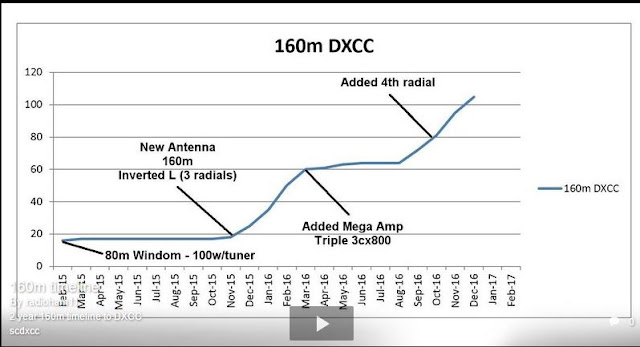
Matt is the epitome of planning and tenacity. Once he gets his mind focused on one thing - he goes at it 100%. I am both impressed and inspired - Kudos to Matt KU4XO. This is the amp he used Triple 3CX800 ceramic tubed. A monster power supply in a separate enclosure.

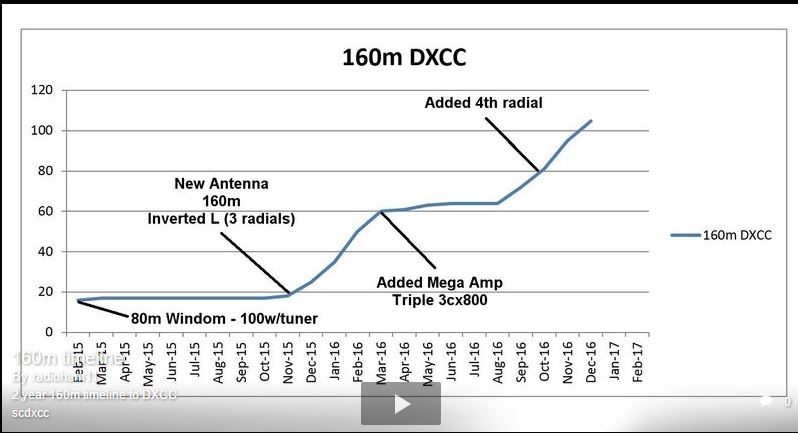
Matt is the epitome of planning and tenacity. Once he gets his mind focused on one thing - he goes at it 100%. I am both impressed and inspired - Kudos to Matt KU4XO. This is the amp he used Triple 3CX800 ceramic tubed. A monster power supply in a separate enclosure.

Saturday, December 24, 2016
Testing the HiPerMite CW Filter
This is a test of the HiPerMite - W1ZY calling CQ on 7013 kHz with strong stations calling a VU (India) station on 7012 KHz. This is a before (Filter in) and after (Filter out). Hear the strong station after I take the filter out. Bandpass is 1.5 KHz with the filter out. The filter narrows thew bandpass to 200 Hz without ringing.
Saturday, December 17, 2016
Senegal 6W/UA4WHX/P

Subscribe to:
Posts (Atom)