Saturday, November 20, 2010

Friday, November 19, 2010
Extra Class Question Review - November 20, 2010
E1A01 (D) [97.301, 97.305]
When using a transceiver that displays the carrier frequency of phone signals, which of the following displayed frequencies will result in a normal USB emission being within the band?
A. The exact upper band edge
B. 300 Hz below the upper band edge
C. 1 kHz below the upper band edge
D. 3 kHz below the upper band edge
ANSWER: When using a transceiver that displays the carrier frequency of phone signals, a displayed frequency of 3 kHz below the upper band edge will result in a normal USB emission being within the band. Note - The inner edge of the side band is 300 Hz away from the center carrier frequency and the outer edgel 2.8 kHz away - thus a center carrier 3 kHZ away will be totally be within the band with 0.2 kHz to spare.
~~
E1A02 (D) [97.301, 97.305]
When using a transceiver that displays the carrier frequency of phone signals, which of the following displayed frequencies will result in a normal LSB emission being within the band?
A. The exact lower band edge
B. 300 Hz above the lower band edge
C. 1 kHz above the lower band edge
D. 3 kHz above the lower band edge
~~
ANSWER:
E1A02
When using a transceiver that displays the carrier frequency of phone signals, a displayed frequency 3 kHz above the lower band edge carrier frequency display will result in a normal LSB emission being within the band. See above.
E1A03 (C) [97.301, 97.305]
With your transceiver displaying the carrier frequency of phone signals, you hear a DX station's CQ on 14.349 MHz USB. Is it legal to return the call using upper sideband on the same frequency?
A. Yes, because the DX station initiated the contact
B. Yes, because the displayed frequency is within the 20 meter band
C. No, my sidebands will extend beyond the band edge
D. No, USA stations are not permitted to use phone emissions above 14.340 MHz
~~
ANSWER:
It is not legal to return the call using upper sideband on the same frequency because your sidebands will extend beyond the band edge.
14.349 MHz + 3 KHz = 14.352 MHz.
The band edge for 20 meters is 14.350 MHz therefore your signal would be out of band by 2 KHz
E1A04 (C) [97.301, 97.305]
With your transceiver displaying the carrier frequency of phone signals, you hear a DX station's CQ on 3.601 MHz LSB. Is it legal to return the call using lower sideband on the same frequency?
A. Yes, because the DX station initiated the contact
B. Yes, because the displayed frequency is within the 75 meter phone band segment
C. No, my sidebands will extend beyond the edge of the phone band segment
D. No, USA stations are not permitted to use phone emissions below 3.610 MHz
~~
ANSWER:
With your transceiver displaying the carrier frequency of phone signals, you hear a DX station's CQ on 3.601 MHz LSB. It is not legal to return the call using lower sideband on the same frequency because your sidebands will extend beyond the edge of the phone band segment.
3.601 MHz - 3 KHz = 3.598 MHz
The band edge for phone on 80 meters is 3.600 MHz; therefore your signal at 3.598 MHz would be out of the band by 2 KHz and in the RTTY and data segment of the 80 meter band
E1A05 (C) [97.305]
Which is the only amateur band that does not permit the transmission of phone or image emissions?
A. 160 meters
B. 60 meters
C. 30 meters
D. 17 meters
~~
The 30 meter band is restricted to RTTY and data transmission only.
E1A06 (B) [97.303]
What is the maximum power output permitted on the 60 meter band?
A. 50 watts PEP effective radiated power relative to an isotropic radiator
B. 50 watts PEP effective radiated power relative to a dipole
C. 100 watts PEP effective radiated power relative to an isotropic radiator
D. 100 watts PEP effective radiated power relative to a dipole
~~
You must do a calculation of transmitter power, antenna gain and line loss to determine your ERP. On the 60 meter band power is limited to 50 Watts ERP, (Effective Radiated Power) referred to a dipole antenna which includes antenna gain and the path loss or gain from the transceiver to antenna itself. If you had an antenna with +6 dB of gain over a dipole and a coaxial line loss of -3dB the maximum output allowed from the transmitter
would be 25 watts. Gain over dipole would be 6 dB -3dB Loss or 3db, therefore you would have to have a transmitter power of 3 db less than 50 watts, or 25 watts transmitter output power.
E1A07 (D) [97.303]
What is the only amateur band where transmission on specific channels rather than a range of frequencies is permitted?
A. 12 meter band
B. 17 meter band
C. 30 meter band
D. 60 meter band
~~
The 60 meter band is the only amateur band where transmissions on specific channels rather than a range of frequencies is permitted.
E1A08 (C) [97.303]
What is the only emission type permitted to be transmitted on the 60 meter band by an amateur station?
A. CW
B. RTTY Frequency shift keying
C. Single sideband, upper sideband only
D. Single sideband, lower sideband only
Upper sideband SSB is the only emission permitted to be transmitted on the 60 meter band by an amateur station.
~~
E1A09 (A) [97.301]
Which frequency bands contain at least one segment authorized only to control operators holding an Amateur Extra Class operator license?
A. 80/75, 40, 20 and 15 meters
B. 80/75, 40, 20, and 10 meters
C. 80/75, 40, 30 and 10 meters
D. 160, 80/75, 40 and 20 meters
~~
The 80/75, 40, 20 and 15 meter frequency bands contain at least one segment authorized only to control operators
holding an Amateur Extra Class operator license.
E1A10 (B) [97.219]
If a station in a message forwarding system inadvertently forwards a message that is in violation of FCC rules, who is primarily accountable for the rules violation?
A. The control operator of the packet bulletin board station
B. The control operator of the originating station
C. The control operators of all the stations in the system
D. The control operators of all the stations in the system not authenticating the source from which they accept communications
If a station in a message forwarding system inadvertently forwards a message that is in violation of FCC rules, the control operator of the originating station is primarily accountable for the rules violation.
Thursday, November 18, 2010
CW TRAINING NET - SATURDAY NOV 20, 2010
Coordinated between 146.820 FM and HF on 80m (CW portion of the Band)
Wait for Net Control to Start the Net
Check-In - Participants declare whether to participate or just listen
Listen for instructions on what frequency to tune to for the HF CW Portion
Agenda:
Basics of CW Operation - moderated by net control on FM
Sample QSOs (example to get the feel and rhythm) on HF
The Morse Alphabet on HF
Participants Check in using CW (as slow as necessary for good transmit)
NEXT WEEK:
Net Control calls CQ
Stations Check In using CW
Net Control Acknowledges Stations and Provides Signal Reports
Stations Report Back Signal Report Given and Gives Signal Report to Net Control
CW Operating Manual - from FISTS.ORG
You are ready to make that first contact. Your palms may be sweating and your heart rate may be racing. That’s ok. We’ve all been there. The first time I called CQ I was very nervous. I didn’t think it was possible for fingers to have a stuttering problem but there I was, stuttering with my fingers. Gradually I relaxed and calmed down. The CQ’s flowed from my fingertips with fluidity before sailing skyward. “Hey, this is really fun,” I thought to myself. Suddenly, the inevitable happened; somebody actually answered! The anxiety returned. “Now, what do I do?” Here is some help with establishing that first contact.
Answering CQ
Let’s suppose you’re tuning across the bands and you hear a station calling CQ. The station seems to be sending at a speed you can copy: CQ CQ CQ DE W5MFC K
To answer W5MFC you just send the following: W5MFC DE (your callsign – lets use mine, NY4G, for our examples) AR
That’s all there is to it. AR is the letters A and R sent with no spaces in between, a procedural signal that means “end of message” or “over.” If the band is noisy or you are running low power, you may want to repeat your call sign twice like so: W5MFC DE NY4G NY4G AR
This is a ‘1x2’. The other station’s call sent once, and yours sent twice. This allows the other station double-check to make sure they got your call right.
If W5MFC was able to copy you, that station will then come back with something like:
NY4G DE W5MFC TNX FER CALL UR RST 559 IN…
If W5MFC only copied part of your call sign, you may hear one of the following. The station may or may not add DE W5MFC depending on the situation:
QRZ? (Who’s calling me?)
? ? (Who’s there?)
KC? (KC something….didn’t get the rest of your call sign.)
OBU? (Got the suffix, but I missed the prefix)
In this case, just send your call sign again.
Calling CQ
If the band seems to be in good shape, but nobody is calling CQ, you can do the following:
1. Find a frequency that seems to be clear, and listen for a few seconds. Listening is very important.
2. If you don’t hear anything, send QRL? and listen for a bit more. Make sure you listen slightly up and down from your transmitting frequency as well. QRL is a Q signal that means this frequency is in use. When you send QRL? you are asking if the frequency is in use. If somebody comes back with C, YES, or QRL, then move to another frequency so you don’t interfere. No further response is needed.
3. If you did not hear a response, send QRL? again and listen again. Some stations may take a bit to respond.
4. Still nothing? You can assume the frequency is clear. Immediately send your CQ while the frequency is still open.
The 3x2 CQ call seems to work well for most situations. Call CQ three times, and then send your call twice: CQ CQ CQ DE NY4G NY4G K
The final K at the end means you’re inviting any station to answer you.
After calling CQ, listen, listen, listen. Listen slightly up and down in case the station trying to answer you is slightly off frequency. You can miss a return call if you are not listening carefully. If you hear nothing, send another 3x2 CQ call again, and listen. Repeat until either somebody answers or you want to try in another spot. Pretty easy, huh?
The 10x2x3 CQ call (CQ sent 10 times followed by your call sign twice, sent three times in a row) is seldom productive. Normally when stations hear this, they will keep moving up or down the band, and you will be scratching your head wondering why nobody is answering your CQ: CQ CQ CQ CQ CQ CQ CQ CQ CQ CQ DE KC0OBU KC0OBU CQ CQ CQ CQ CQ CQ CQ CQ CQ CQ DE NY4G NY4G CQ CQ CQ CQ CQ CQ CQ CQ CQ CQ DE NY4G NY4G K
The QSO
Basically there are three parts to a QSO: The introduction, the middle, and the conclusion. Almost sounds like a term paper. Let’s take a look at each of these parts.
The Introduction
Once a CQ is answered, the stations first exchange three important pieces of information: RST (a signal report), QTH (location), and Name. So let’s suppose I am calling CQ and WA3XYZ answers me. I would then send something like this:
W5MFC DE NY4G GM (GA, GE, GN) TNX CALL UR 559 (579,549, etc) 559 IN TR, SC TR, SC NAME ARIEL ARIEL HW? AR W5MFC DE NY4G KN
First I send the other station’s call, then DE (which means from) and then my call sign. Then I say good morning (GM), afternoon (GA), evening (GE), or night (GN), whichever is appropriate. Next I say thanks for the call (TNX CALL) and give the RST signal report (UR 559. I then send my QTH or location followed by my name. You can send ‘QTH’ instead of ‘IN’. But don’t send ‘MY QTH IS’ because that would be redundant….sort of like saying ‘MY MY LOCATION IS IS’.
‘HW?’ is short for ‘How are you copying me?’. Then I send AR (Over or End of Transmission), W5MFC DE NY4G (so other stations listening will know who we are) and KN which says go ahead to a specific station, which in this example is WA3XYZ.
The other station will then reply back with its information by sending something like the following: NY4G DE W5MFC R GM ARIEL NICE TO MEET U UR RST 579 579 QTH GREER, SC GREER, SC NAME MIKE MIKE HW? AR NY4G DE W5MFC KN
The R sent after the initial call signs means that the other station copied EVERYTHING that you sent. Don’t send R and then ask the other station to repeat part of the information that was sent. It’s bad form.
If you need the other station to repeat something send ‘PSE RPT NAME’, or ‘RST’, or ‘QTH’, etc. You can also send something like ‘NAME?’ or’RST?’ in your next transmission, and the other station should understand.
The Middle
Now, you chat back and forth about whatever you want: the weather, sports, your rigs, antennas, etc., using a format like the following: W5MFC DE NY4G R blah, blah, blah, AR W5MFC DE NY4G KN
Then the other station has a turn: NY4G DE W5MFC R blah, blah, blah, AR NY4G DE W5MFC KN
Technically, you don’t have to send both call signs with each transmission. Some stations just send BK (back to you) and the end of a transmission and then legally identify the station every 10 minutes. Other stations will send both calls with each transmission so those listening will know who they are.
The Conclusion
To end the QSO just send something like: W5MFC DE NY4G R blah, blah, blah, OK MIKE TNX NICE QSO HPE CUL 73 GM SK NY4G DE W5MFC K
I thank Phil for a nice QSO, say hope to see you later (HPE CUL), send best wishes (73), and good morning (GM). The SK procedure signal means that’s all I have. Similar to AR except it is only used in the final transmission from your station. Phil will then send his final transmission: NY4G DE W5MFC R FB DAN TNX QSO 73 SK KCNY4G DE W5MFC CL
The CL means that Phil is going to be closing his station and won’t be answering any more calls. Phil could also end his call with a “dit dit”. I would respond with a single dit.
Ending a QSO with the dit dit – dit, or the “shave and a haircut…two bits” is a friendly way of acknowledging that the QSO has ended and you enjoyed the chat. It started back before anyone can remember with one Ham sending ‘shave and a haircut’ – dahdididahdit - and the other station completing it with ‘two bits’ – dit dit. It has shortened over the decades to stations sending ‘dit dit’ and ‘dit’’.
Please don’t fall into the habit of pluralizing. There is no need to send “73s”. 73 by itself means “best wishes”; it is not proper to send 73s or ‘best wisheses’
Another tip to remember is that most Procedural Signs (like QTH) already mean phrases, and are intended to reduce the amount of sending you need to do to make your point. You don’t need to use extra words when using prosigns like QTH. QTH PA is sufficient, not MY QTH IS....
A Cheat Sheet
You might find it helpful to use a cheat sheet that you can refer to when your mind suddenly goes blank. So here it is. Just fill in the blanks and replace W5MFC with the other station’s call sign.
Is this frequency in use?
QRL? (then LISTEN)
Calling CQ
CQ CQ CQ DE _____________ K
Answering another station’s CQ
W5MFC DE ___________ AR
When another station answer’s your CQ
W5MFC DE __________ GM (GA, GE, GN) TNX CALL UR 559 (or 579, 549, etc) 559 IN ______________, __ ______________, __ NAME _______ _______ HW? AR W5MFC DE __________ KN
To end the QSO
W5MFC DE __________ R blah, blah, blah, OK TNX NICE QSO HPE CUL VY 73 GM SK W5MFC DE __________K
If the other station initiates ending the QSO
W5MFC DE __________ R OK TNX NICE QSO HPE CUL VY 73 SK W5MFC DE __________
A Final Word about Speed
Accuracy transcends speed. Most operators would rather copy slower accurate code with proper spacing than code sent fast with uneven spacing and lots of mistakes. Speed will come with practice.
Rule of thumb for spacing: The space between letters should be about as long as a dash – which is equal to 3 dits. The space between words should be about as long as two dashes (technically, 7 dits, but it’s easier to estimate ‘two dashes’ since you DON’T want to start counting). Keep in mind that the person on the other end has to decipher your sending, so make it as clear for them as you can. Spacing is just as important as the letters themselves. Without spacing, it’s all gibberish! Space between your letters, and pause ever so slightly between words.
It is asking for trouble to call CQ with a speed faster than you can comfortably copy, because that will probably be the speed somebody will use when answering you. Don’t get frustrated if the other station doesn’t slow down for you, even after you have sent PSE QRS (please send slower). The other station may be pressed for time, in the heat battle during a contest, or has been operating at a fast speed for so long that they have difficulty copying or sending slower. You also need to be courteous. Do not assume that everyone who does not slow down is being a jerk. If you cannot copy the other station, just say SRI TOO FAST, send them a 73 and move on. You are sure to find somebody that you can work.Thursday, November 11, 2010
CW Training Net
Idea1: Use the 820 machine for he Extra Class Content and CW Coordination
Idea2: Use the 80m CW band for the CW training in the evening
Sunday, October 31, 2010
CW Contacts
Thursday, September 9, 2010
Earth Dodges Another Solar Bullet
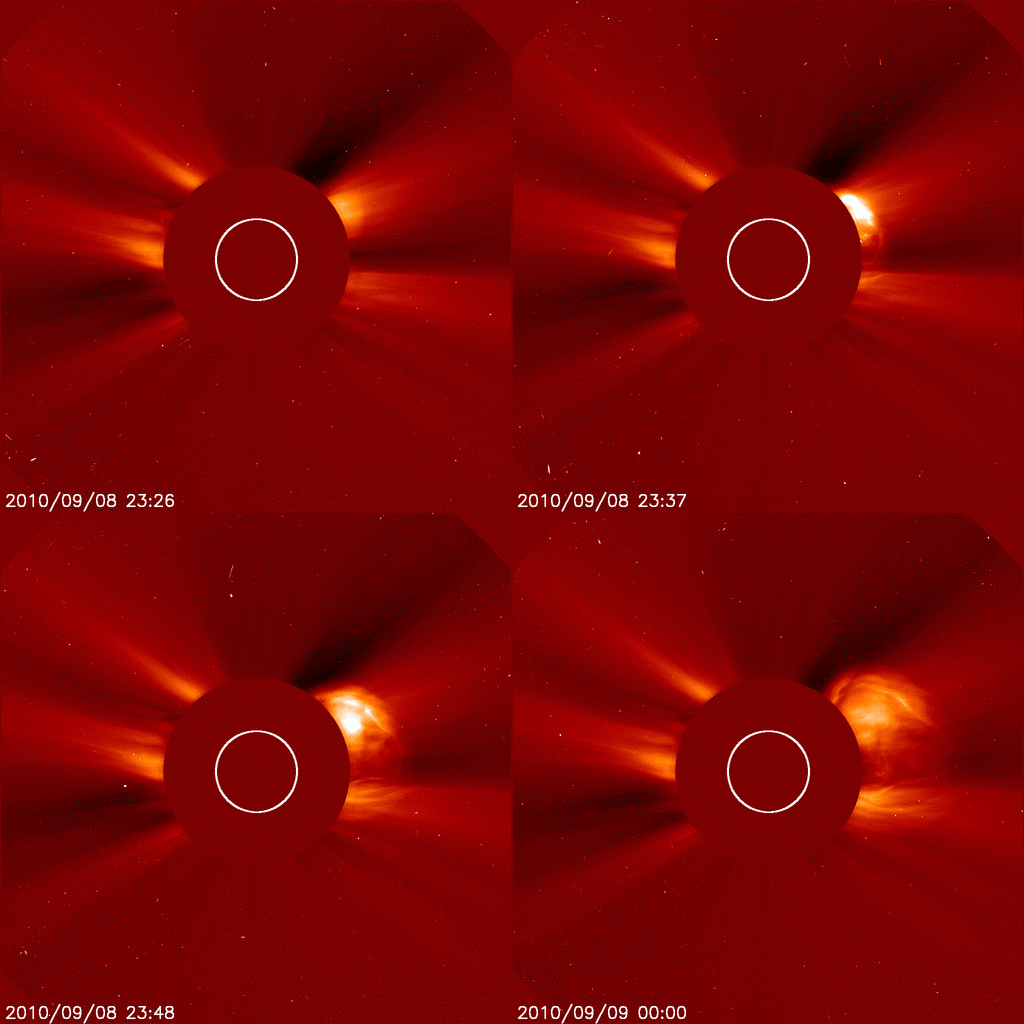
 Just as sunspot 1105 was turning away from Earth on Sept. 8th, the active region erupted, producing a C3-class solar flare (peak @ 2330 UT) and a fantastic prominence. Here is a snapshot from the Solar Dynamics Observatory:
The eruption also hurled a bright coronal mass ejection (CME) into space: SOHO movie. The expanding cloud is heading into a part of the solar system not currently occupied by any planet--it's going to miss everything, including Earth. If such a CME did hit Earth's magnetic field, it would probably trigger strong geomagnetic storms. Maybe next time...
Update #1: Two new movies of the eruption are available from the Solar Dynamics Observatory--a big picture view in black-and-white and a spectacular close-up in three extreme ultraviolet colors.
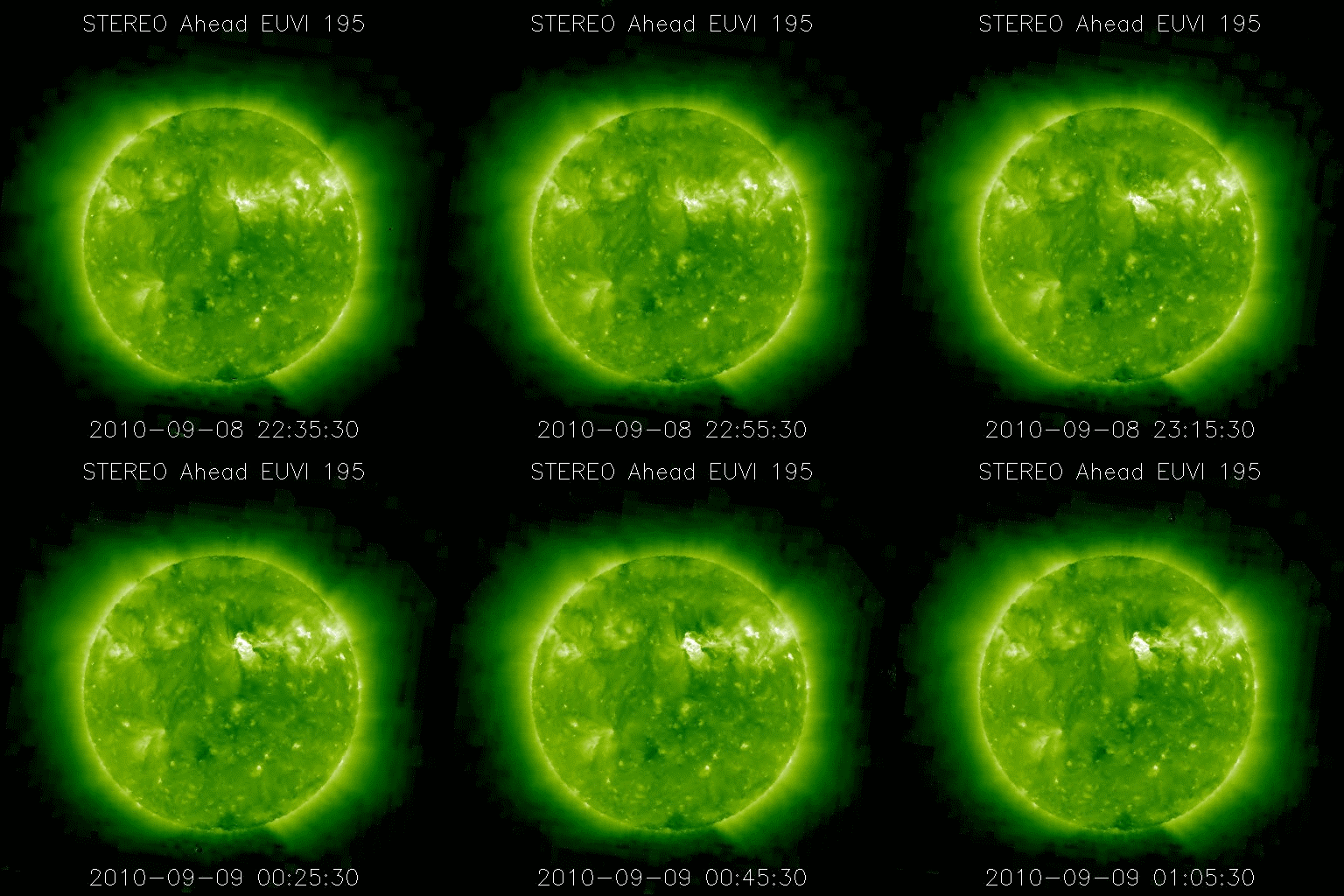
Update #2: NASA's STEREO-Ahead spacecraft is stationed almost directly above sunspot 1105. A first-look movie shows a shadowy "solar tsunami" wave racing away from the blast site.
Monday, September 6, 2010
New Equipment
Sunday, August 22, 2010
TS830S 40m band is back
Saturday, August 14, 2010
Friday, August 13, 2010
Propagation News
ARLP032 Propagation de NW7US


This week's bulletin was written by Tomas Hood, NW7US.  Tomas is filling in for your regular reporter Tad Cook, K7RA.

Sunspot numbers and solar flux increased this week, with average daily sunspot numbers up over 32 points to 53, and the average daily
10.7-cm solar flux up over 3 points to 84.5.  These are the numbers from last Thursday through this Wednesday, August 5 through August
11.

The sunspot count on August 11 was 66, consisting of four active sunspot regions, NOAA Active Regions 1093, 1095, 1096, and 1097.
The largest of these was 1093 with a relative size of 130 millionths of a solar hemisphere.  The sunspot count of 66 is the highest yet
recorded in Sunspot Cycle 24.  Another note-worthy development this week is that five active sunspot regions were reported on August 12.
However, most of the spots were small, resulting in a daily sunspot count of 50.

Another news-worthy event was the M-class X-ray flare that erupted from active sunspot region 1093 on August 7.  This flare was 10
times more powerful than the C-class flare on August 1 that caused so much News Media attention on August 3 through August 5.  This
M1.0 magnitude solar flare peaked at 1824 UTC on August 7 and ejected a huge mass of coronal plasma.  Many hoped that the coronal
mass ejection, or CME, originating from the sunspot region 1093 would trigger auroral displays around the world just like those that
occurred last week.  However, because this CME was not fully Earth-directed, most of the CME missed the magnetosphere, resulting
in only the slightest increase in geomagnetic activity between August 10 and 11.

This flare, one of the biggest since the start of Cycle 24, also triggered a metric type II radio burst.  This kind of radio burst
can be heard from a radio receiver tuned to, say, a six-meter frequency as the burst occurs.  The burst sounds like rushing wind.
You can hear a recording of a type II radio burst as recorded on 50 MHz by Thomas Ashcraft on April 2, 2001 at 2151 UTC that occurred
during the X22.0-magnitude X-ray flare, by browsing to http://tinyurl.com/50MT2RB.  Incidentally, the April 2, 2001 flare
is the second largest event on record after the X28.0-magnitude mega-flare that occurred on November 4, 2003.

A movie of the August 7 M-class flare showing a series of filtered views of the event as seen by the Solar Dynamics Observatory's
Atmospheric Imaging Assembly can be viewed at http://tinyurl.com/20100807mflare and is available in high
definition.
Thursday, August 12, 2010
Meteor Showers Tonight
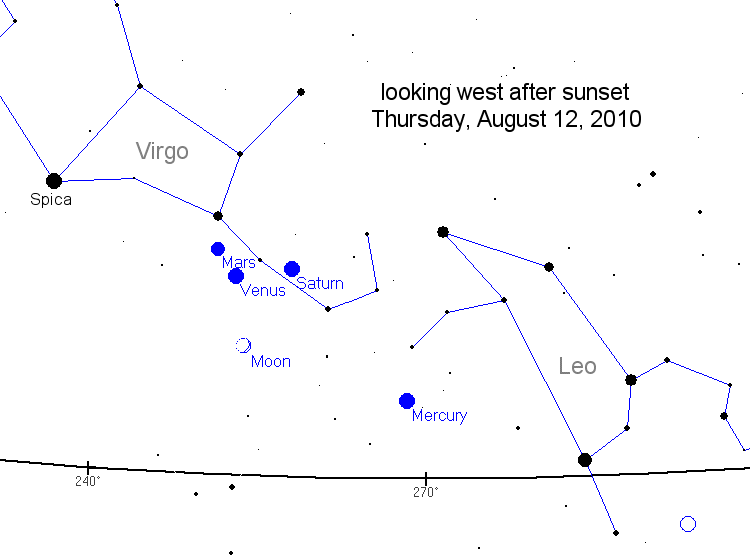
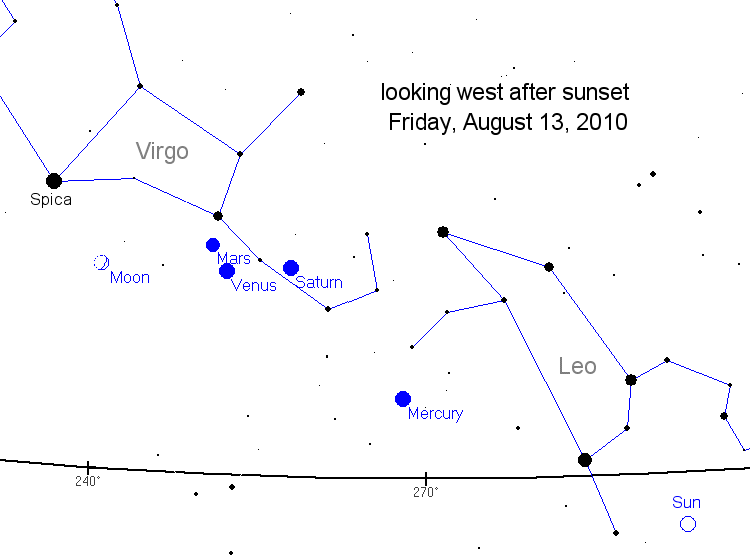
SUNSET PLANET SHOW: When the sun goes down tonight, step outside and look west. Venus, Mars, Saturn and the crescent Moon are having a lovely 4-way conjunction. It's a great way to warm up for the Perseid meteor shower, which peaks on Thursday night, August 12th. Get the full story from Science@NASA. Sky maps: August 12, 13.
PERSEID METEOR SHOWER: The annual Perseid meteor shower is underway. According to the International Meteor Organization, dark-sky observers are now counting more than 35 Perseids per hour, including many fireballs. Be alert for Perseids from 10 pm on Thursday, Aug. 12th, until sunrise on Friday, Aug. 13th. The darkest hours before dawn are usually best.
Wednesday, August 11, 2010

History of Geomagnetic Storm Damage
August 2, 1972 – A solar storm caused a 230,000 volt transformer located at the British Columbia Hydro and Power Authority to explode
December 19, 1980 – A very expensive 735 kV transformer failed 8 days after the Great Red Aurora of 19 December at St. James Bay, Canada.
April 13, 1981 – A replacement 735 kV transformer at St. James Bay, Canada also failed the next year during another geomagnetic storm.
March 13, 1989 – At 02:45 EST on March 13, geomagnetically induced currents (GIC) inundated the transformers of the Hydro-Quebec power system and overloaded them with current. The voltage fluctuations that resulted prompted the tripping, or deactivation, of reactive power compensators at the Chibougamau, la Verendrye, Nemiscau and Albanel substations. A severe voltage drop resulted; the power lines from James Bay malfunctioned and the system collapsed. It was later determined that the power lines were substantially vulnerable due to their great length and the number of static compensators that ran along their distance. The Hydro Quebec outage resulted from the linked malfunction of more than 15 discrete
protective-system operations. From the initial event to complete blackout, only one-and-a-half minutes elapsed—hardly enough time to assess what was occurring, let alone to intervene.15 The blackout resulted in the loss of 21,500 megawatts of electricity generation. It took nine hours to restore 83% of that electrical load. The blackout affected 6 million people. The physical damage included a 1,200-ton capacitor failure at a Static VAR Compensator (SVC), overvoltage damage to two step-up transformers at the La Grande 4 generating station, surge arresters at the La Grande 2 and Churchill Falls generating stations, and to a shunt Figure 2. Earth ground resistivity based on underlying rock strata. Conductivity measurements from the Geomagnetic
Laboratory of the Geological Survey of Canada in Ottawa with Extension to the United States Completed by Electric Power Research Institute – Sunburst Project. Units – siemens per meter.
(regions in red are very non-conductive). reactor at the Nemiscau substation, and damage to the SVCs themselves.
March 13, 1989 – The solar storm destroyed a $12 million generator step-up transformer owned by the Public Service Electric and Gas Company of New Jersey. The transformer was a linchpin in converting electricity from the Salem Nuclear Generating Plant. The 288.8/24-kV single-phase shell-form transformers, which are rated at 406 MVA, are connected grounded-wye. The damage to the transformers included damage to the low-voltage windings, overheating, thermal degradation of the insulation of all three phases, and conductor melting.12 The utility asked the supplier for a replacement and was told thatthe order would receive top priority, but it would still take almost two years to fill. Fortunately a spare transformer was made available, but it still took 6 weeks to install.
October 30, 2003 – A power grid in southern Sweden located in Malmo experienced a 20-50 minute electrical blackout affecting 50,000 customers due to a strong solar storm. The same storm caused significant transformer damage in South Africa. Over 15 transformers in South Africa were damaged, some beyond repair.
Sunday, August 8, 2010
Solar Blast Just Missed Earth

SOLAR BLAST JUST MISSES EARTH: On Saturday, August 7th, magnetic fields around sunspot 1093 erupted. NASA spacecraft and many amateur astronomers photographed the blast, which produced a strong M1-class solar flare and hurled a coronal mass ejection (CME) into space--apparently just missing the sun-Earth line. The explosion also made whooshing sounds in the loudspeakers of some shortwave radios. Visit http://spaceweather.com for audio recordings and movies of this latest solar event.
AURORA RECAP: Last week's geomagnetic storm sparked Northern Lights as far south as Iowa in the United States, and some nice Southern Lights over Antarctica. See photo above